Composite vs uPVC vs Timber Front Doors
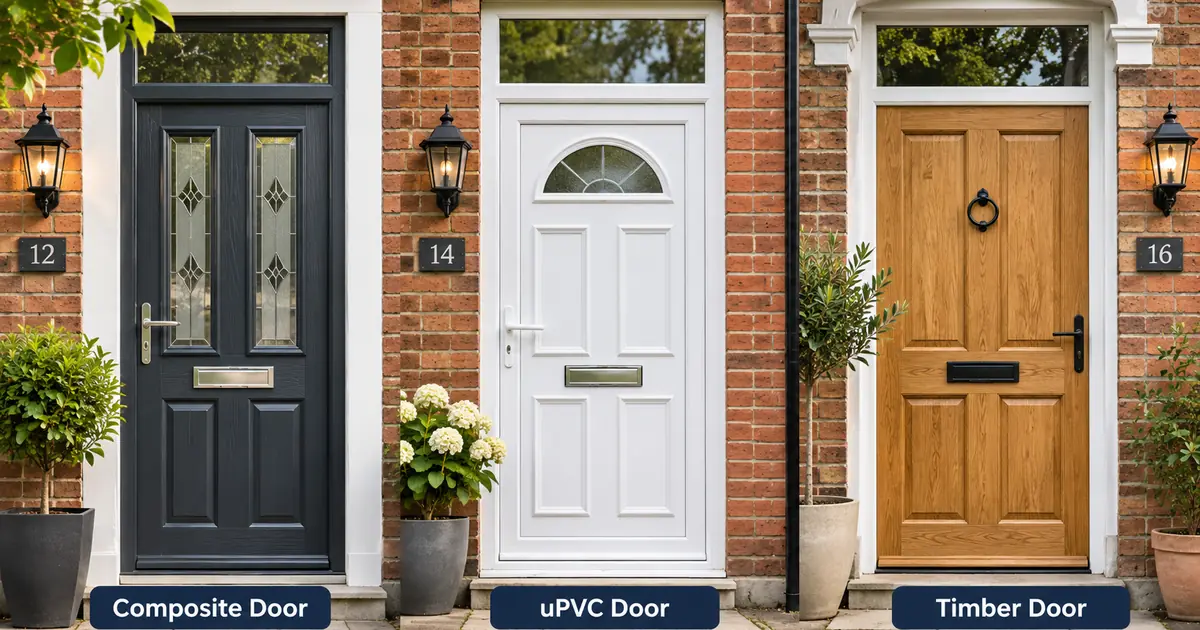
Spend ten minutes on a London street and you will see all three. A timber door on a Camden terrace with its paint starting to lift. A white uPVC door on a 1930s semi in Barnet. A smart woodgrain composite in Islington that could pass for hardwood. Each one made sense to somebody. This guide compares composite vs uPVC vs timber doors, so you can work out which one makes sense for your front door, without the sales pitch.
Composite, uPVC or timber? Pick the one that suits your house.
Each material wins in a different place. The right one depends on your budget, how much upkeep you will put up with, and what your street and your doorway can carry.
The short version
- 1CompositeTimber look, little upkeep, mid to higher cost.
- 2uPVCTightest budgets and the simplest styles.
- 3TimberThe real thing, if you will keep it up.
Free survey · Written quote · No obligation
We supply and fit composite and uPVC doors across North London, and the Fairglass team sees how they behave once the first winter has passed. Before we order anything, we survey every doorway, because the opening decides more than the brochure does. We will tell you where each material wins and where it does not.
The Short Answer: Which Front Door Material Suits You?
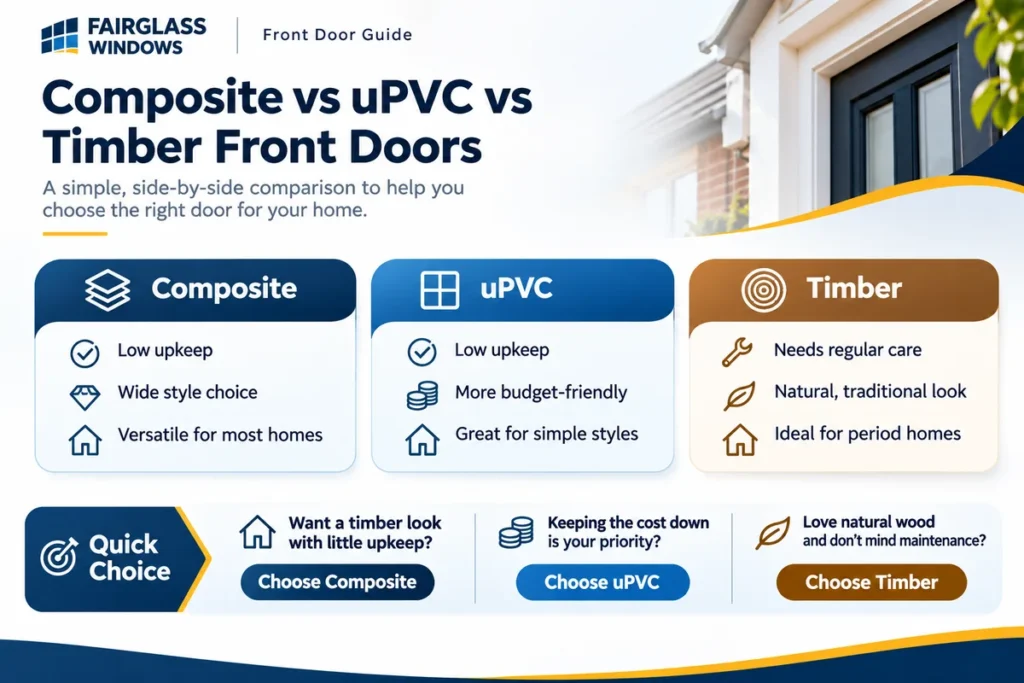
Choose composite if…
You want a door that looks like painted or stained timber but does not need repainting, and you are happy to spend more than the cheapest option for a solid feel and a wider choice of designs. If that is you, take a look at the composite front doors we supply and fit across North London to see what a good specification looks like.
Choose uPVC if…
Your budget matters most, you like clean, simple lines, and you want low upkeep. It also works well when you are matching new uPVC windows in the same style.
Choose timber if…
You love the real thing, you are in a period home where timber suits the street, and you do not mind painting or staining it every few years.
How Each Front Door Material Is Made
The labels hide a lot of difference. Knowing what is under the surface helps you judge a quote.
Composite
A composite door has an outer skin, usually glass-reinforced plastic (GRP), over an insulating core, held in a frame. Makers build them differently, so always ask for the specification of the exact door you are being quoted.
uPVC (PVC-U)
A uPVC door is built from PVC-U profiles, typically with several hollow chambers and often a steel reinforcement inside for strength. The panels can be solid or glazed, and colours are usually achieved with a coloured or foil finish.
Timber
A timber door is made from softwood or hardwood, or from engineered timber designed to resist movement. It is the most traditional choice, and the only one you can sand, fill and refinish in the old-fashioned way.
Does a thicker door mean a better door? Not on its own. Thickness is easy to put on a brochure, but how a door performs depends on what it is made of, how it is built, the locks and hinges, and how well it is fitted. Two doors of the same thickness can behave very differently. When you compare quotes, ask about construction and hardware, not just millimetres.
Composite vs uPVC vs Timber Doors: Side-by-Side Comparison
This is a general guide. Individual doors vary by maker and specification.
| CompositeGRP skin, insulating core | uPVCPVC-U profiles | TimberSoftwood or hardwood | |
|---|---|---|---|
| Upkeep | Very low | Very low | Regular painting or staining |
| Look | Woodgrain or smooth, many designs | Simpler, fewer designs | Natural, most traditional |
| Weight | Usually heavier | Usually lighter | Varies with wood and design |
| Repairs | Depends on the damage; often parts or panels | Depends on the damage; often parts or glass | Can often be planed, filled and refinished |
| Insulation | Depends on construction | Depends on construction | Depends on wood and build |
| Lifespan | Many years with a good build and fit | Many years with a good build and fit | Many years if kept up; neglect shows quickly |
| Cost level | Usually mid to higher | Usually lowest | Varies widely |
| Style range | Wide | More limited | Widest if made to order |
| Best suited to | Period and modern homes wanting low upkeep | Budget-led, simple styles | Period homes, owners who enjoy upkeep |
Upkeep, Lifespan and Repairs
Which front door material needs the least maintenance?
Composite and uPVC both need very little: a wipe with warm soapy water, a quick clean of the seals, and a drop of lubricant on the lock and hinges now and then. Timber is the high-maintenance option. London weather is not kind to exposed wood, so expect to repaint or re-stain on a regular cycle. If you do not enjoy that job, be honest with yourself now.
Which material is easiest to repair?
Timber, in the traditional sense. A scratch can be filled and painted, and a sticking edge can be planed. Composite and uPVC are harder to patch cosmetically, so repairs often mean replacing a part, a panel or a glass unit. Always check the maker’s advice and your guarantee before trying a repair or repaint yourself.
One more thing worth knowing: a new door that catches slightly or needs a hinge adjustment in its first weeks is usually a settling-in job, not a failure. We explain how snagging after fitting works so you know what to expect.
Matching the Door to Your Home
The best material depends on the house as much as on you.
Victorian and Edwardian terraces
In streets of London stock brick and tiled paths, such as those you find across Islington and Camden, a panelled door with a little glazing feels right. Timber is the purist’s answer, and a good woodgrain composite is the low-upkeep one. If your street is protected, check the rules for conservation areas before you choose, because some roads also have an Article 4 direction that adds restrictions. Whether you need planning permission at all depends on your street and your property, so confirm it with your council first. A listed building has stricter rules still.
1930s and modern homes
A bay-fronted 1930s semi in Barnet or Enfield often has a porch and a wider opening. Glazed and part-glazed designs are popular here, and both composite and uPVC can do them well. Newer builds usually suit cleaner, flatter designs.
Sunny or exposed fronts
A south-facing front takes more sun, and a dark colour takes more heat. Any material can be affected by prolonged exposure, so construction and finish matter more than the label. If your door faces strong sun or sits straight onto the pavement, tell your installer before choosing a dark colour.
Kerb appeal and what buyers notice
The front door is the first thing a visitor, or a buyer, sees. A tired door makes a tidy house look neglected, and a well-chosen one lifts the whole front. That is a reason to choose a style that suits the street rather than the loudest option in the showroom.
Will a composite door match my uPVC windows?
It can go with them, but a perfect match is rare. A composite door and uPVC windows are made of different materials, so the colour and the surface texture will rarely be identical. White windows with a coloured door is a popular and forgiving combination. If you want the same colour, ask for samples and view them side by side in daylight.
Does a porch change which door you should choose? Yes, it can. A sheltered door sees less rain and less sun, so timber and dark colours cope better. An open front on a busy road takes the weather and the traffic dirt, which favours something you can simply wipe clean. Many London terraces have no porch at all, which is one reason low-upkeep materials are so popular.
Common Myths About Front Door Materials
“Composite is always more secure”
Not by material alone. Security comes from the whole door set: the lock, the cylinder, the hinges, the frame fixings and the glass. A well-specified uPVC door can beat a poorly specified composite one. Ask what has been tested, and for which exact door.
“uPVC means cheap and weak”
A good uPVC door is a solid, practical choice. It is simply plainer than a composite, with fewer designs. Cheap and weak describes a poor specification, not the material.
“Timber is always the warmest”
Wood does insulate, but how warm a door feels depends on its construction, its seals and the fit. A well-built composite or uPVC door can match or beat a poorly fitted timber one.
Cost: How the Three Compare
We do not quote prices in a guide, because every doorway is different, but the general pattern is clear.
uPVC is usually the lowest cost.
Composite usually sits in the middle to higher range.
Timber varies widely, from a modest softwood door to a bespoke hardwood one that costs more than either.
The cheapest door to buy is not always the cheapest to own. A timber door needs regular painting, and that adds up over the years. A composite costs more at the start but asks little afterwards. A uPVC door sits in between on price and gives you simple, steady upkeep.
When you compare quotes, compare what is included as well as the headline figure. If you are comparing installers, ask each one to price the same specification.
How to Decide: A Simple Checklist
Ask yourself these six questions, and your answer is usually clear:
Paperwork to keep, whichever material you choose
Replacing an external door falls under the building regulations for replacement doors, so ask for the Building Regulations paperwork and keep it safe. It matters later: our note on selling without a certificate explains why a missing one can slow a sale. If you live in a flat, read about flats and leasehold homes first, because the lease and the building’s rules can decide the material for you.
Still torn between the three? Let us look at your doorway.
Send us a photo of your door and your postcode. We will tell you what we would need to see, then arrange a free survey and a written quote.
- Free survey
- Written quote
- Start with a photo
Front Door Material FAQs
A few things homeowners commonly want to know before getting in touch. If your question isn’t covered here, contact us directly.
Final Thoughts
Composite, uPVC and timber are not rivals in a race, because each one wins for a different kind of homeowner. Composite rewards those who want timber looks without the repainting, uPVC rewards those who want simple, dependable value, and timber rewards those who enjoy caring for something traditional. None of the three is wrong. The mistake is choosing on a label rather than on a specification, so compare like with like and ask what each door is made of and what each price includes. Pick the material whose trade-offs you are happy to live with, and the rest of the decision usually takes care of itself.